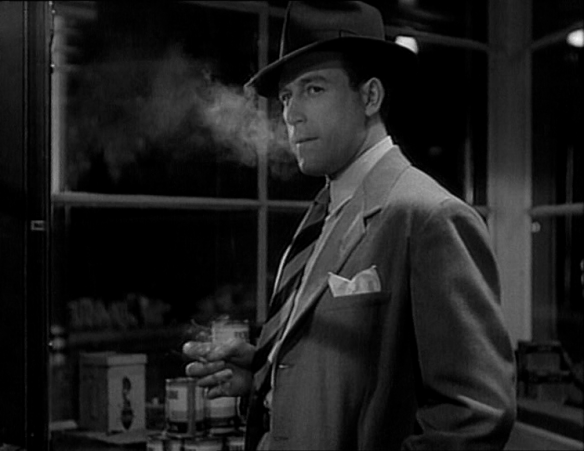
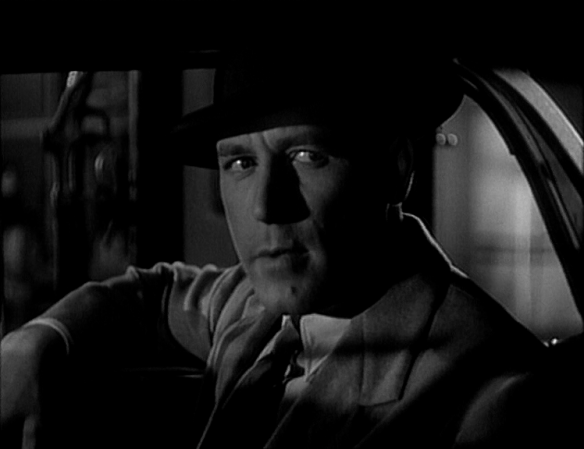
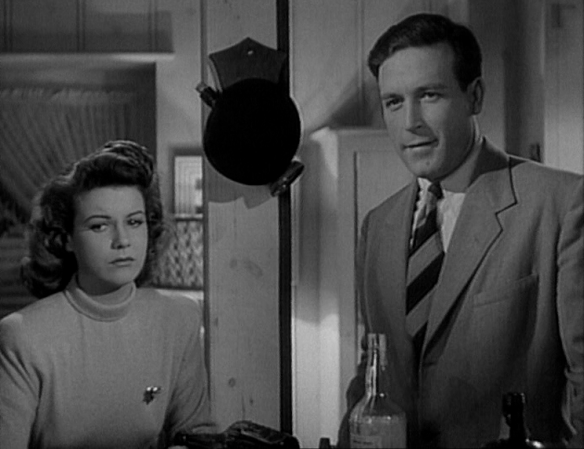
Free Friday Film: Eyes in the Night (1942)

4

The small, rotund man cannot see, although the light is on. He stands in a basement and in a few moments, his enemies will descend to kill him. But he’s not concerned. He taps his cane around the ceiling, listening to the sound it makes on the pipes, until he finds the suspended single-bulb lamp. And with a wry smile and a swing of his cane, he bashes it and plunges the room into total blackness.

11

“You haven’t got a chance, blind man.” Two shots peal into the darkness: tiny, instantaneous streaks of light. A metallic noise jangles from one part of the room. Another futile shot. Another clanging feint. Another shot.

“Where are ya?” The adversary’s voice calls, suddenly frightened.

“In the dark… in the dark. In my kingdom.”

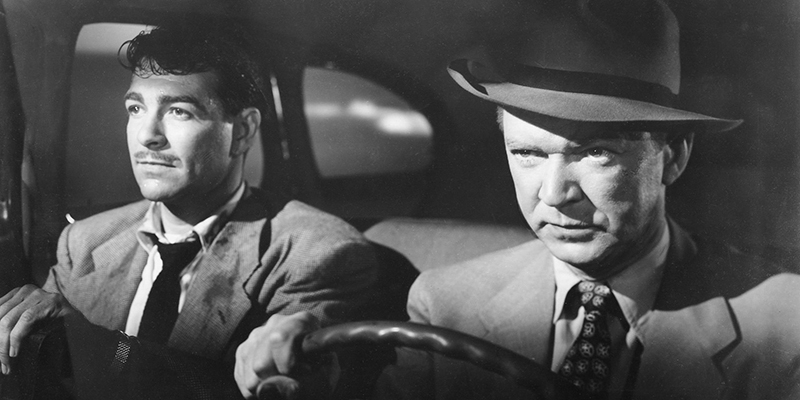
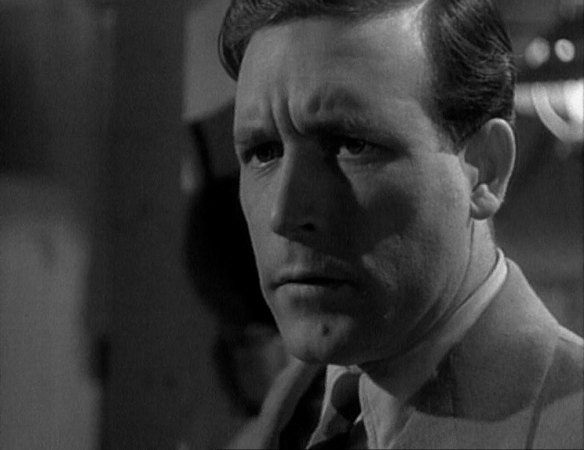
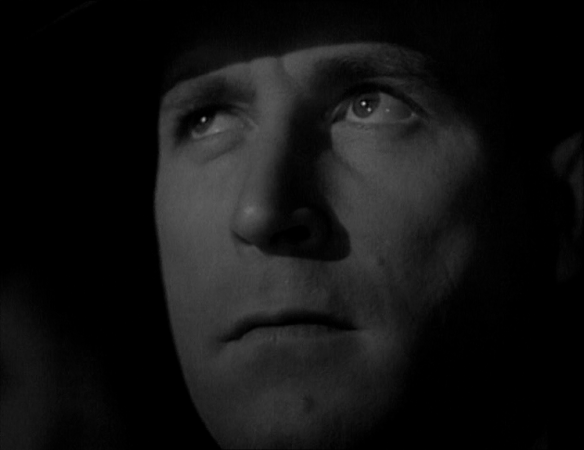
As this tense confrontation plays out in Eyes in the Night, the screen remains almost totally black, punctuated only by a few sparks of gunfire. This film about Duncan Maclain, a detective with a visual impairment reaches its climax by forcing the viewer to live his condition for a nail-biting few minutes. By doing so, this MGM thriller establishes a striking bond of sympathy between the audience and its protagonist and shocks us by denying the visual clarity and self-effacing continuity that we expect from a classical Hollywood film.

1

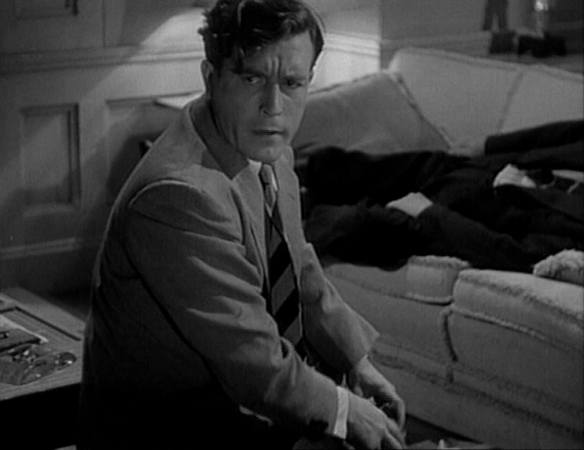
Usually, we movie spectators feel by seeing. We let our eyes supply the necessary information to our sensory memory to understand what the characters are experiencing and our vicarious impression of action, whether it’s a slug to the jaw or a smooch. Our blind protagonist reverses this sensorial metonymy: he sees by feeling. Whether using an awl and a braille template to take notes or stroking the floor of a crime scene to determine which way a corpse was dragged, his fingers guide our eyes in haptic contemplation and force us to recognize the strange link between eyes and touch, a relationship inverted between the seeing audience and Maclain.

When Eyes in the Night aired on Turner Classic Movies this past autumn, I tuned in, anticipating a run-of-the-mill potboiler. I was quite surprised how much this yarn has stayed with me since then. During a dark evening spent at a tense house where Nazis lurk behind every balustrade, Maclain’s sightless eyes paradoxically “see” more than anyone else can. He navigates the blackness with ease and skill; his enhanced senses cloak him with an almost uncanny power.

4

The plot offers up one of those odd mashups of domestic drama and international intrigue, in varying degrees, that you get in the 1940s (think The Stranger, Ministry of Fear, Secret Command, or even Mrs. Miniver). In this case, Duncan Maclain, a detective who retired after losing his sight, is asked by a friend to put an end to her stepdaughter’s unhealthy relationship with an older man—and inevitably ends up uncovering an Axis plot during WWII. Did I mention that the bratty stepdaughter’s father is a preeminent scientist, working on research vital to the war effort? Do I need to? Or could you have surmised that already?

The film made it to TCM primetime not because of its nutty plot contrivances, but as a selection from guest-programmer Lawrence Carter-Long, Executive Director of the New York City Disabilities Network, who organized a series around the theme of disability. I’m very grateful that this novel B-movie came to my attention and today I’d like to share it with all of you.

1

In addition to its sensitive portrayal of blindness, Eyes in the Night deserves to be watch for its place in Fred Zinneman’s authorial canon as one of his first features, along with Kid Glove Killer which he also shot in 1942. According to the informative TCM article about this movie, Zinneman, who would go on to give us From Here to Eternity and High Noon. didn’t give this film a lot of respect when he reflected on his career. Nevertheless, I would categorize it as a promising debut with a strong noirish flair and one brilliantly ahead-of-its-time stylistic set piece, the fight in the dark. The performances instill what might’ve been a colorless entry in the spy thriller genre with a deliciously melodramatic ambiance.

3

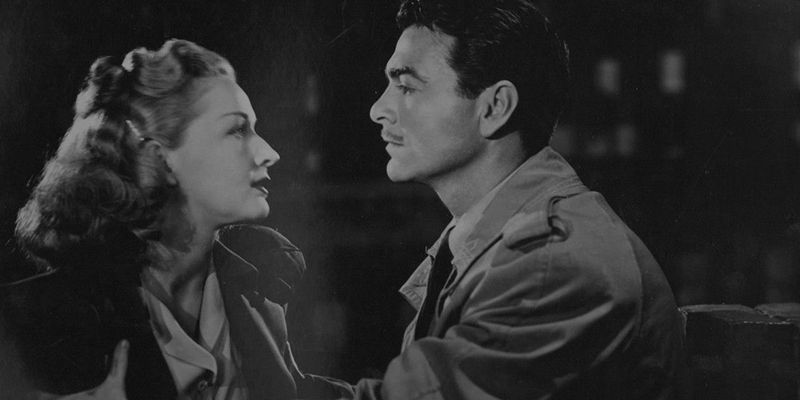
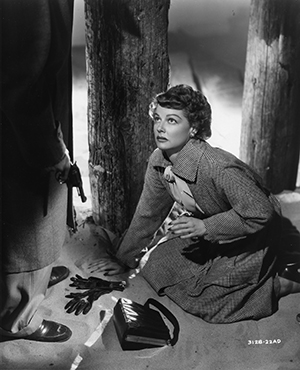
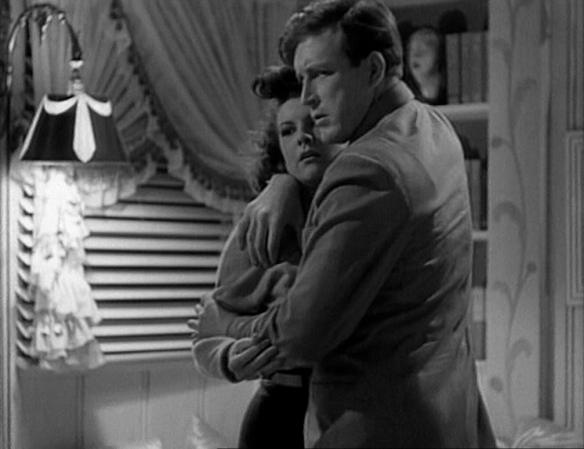
Ann Harding, returning to the screen after her nervous breakdown, makes the most of a thankless stepmom role as an actress now happily married to the aforementioned Dr. MacGuffin—er, Dr. Lawry. You can read genuine concern over her wayward stepdaughter in her sincere eyes and graceful gestures. Faced with an ex-lover who’s now romancing her husband’s daughter, she goes to meet him in a theater and listens to this aging Don Juan’s florid protestations:

“I love Barbara, utterly and devotedly. If she’ll have me, I’ll marry her. All my life I’ve waited for someone like her—beautiful and talented. Alive as a breath of spring. Now that I’ve found her I’ll never let her go.”

Never missing a beat, she starts clapping, adding a sarcastic, “Bravo…You ham!” What do you know? Mom’s got some backbone! And a whole lot of fortitude.

3

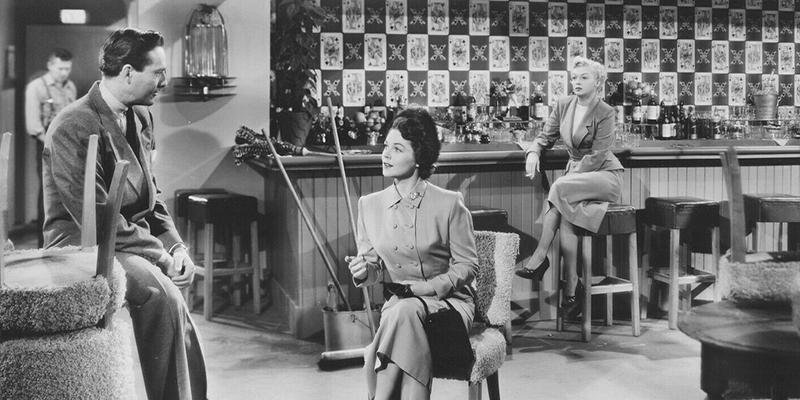
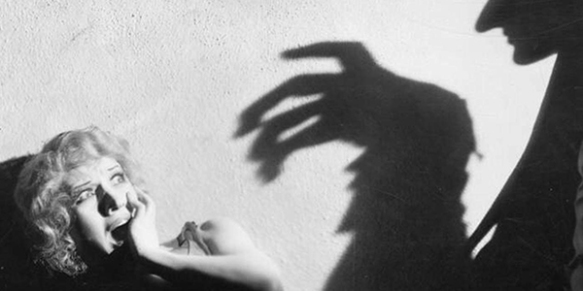
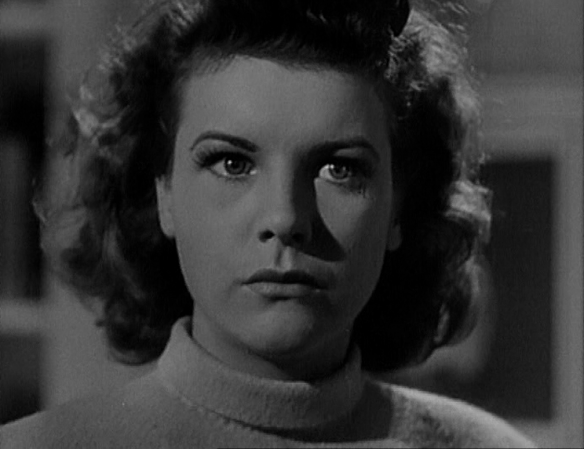
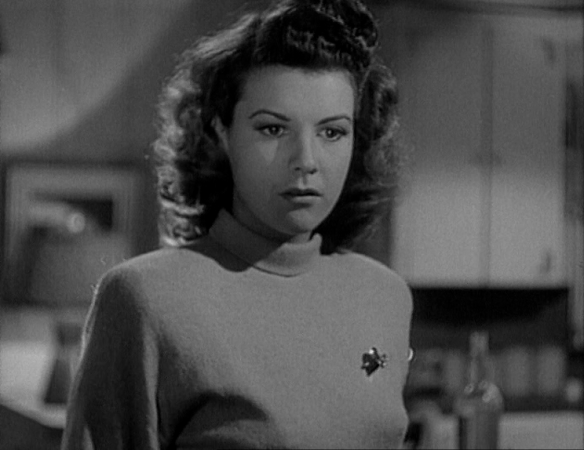
Of course, anyone who could spend five minutes in the presence of that stepdaughter without slapping her silly must’ve had more patience than Stanley Kubrick’s clapper loader. Annoying to the point of sociopathic bitchiness, Donna Reed milks her honey-voiced tramp part for all it’s worth. I must confess, I never would have imagined the soon-to-be Mrs. George Bailey capable of hissing nasty, sexually precocious insinuations at her saintly stepmom, like the following:

“It seems to me your duty is perfectly clear, then. You should go to my father and tell him that I’m going out with a bad man. And when he asks you how you know he’s a bad man, tell him. Tell him you know from personal experience.” [Wink, wink!]

The cast also features Friday, a mischievous, scene-stealing canine of the heroic Rin-Tin-Tin ilk, as Maclain’s loyal seeing-eye dog.

2

This film was released right in the middle of World War II, so its Nazis-turned-amateur-theatrical-players might strike the modern viewer as quaintly amusing, but would have probably seemed much more menacing to 1940s audiences. Lest we forget, the Nazi ideology advocated eugenics, specifically the extermination of those with disabilities, considered unfit to procreate.

As a person with a visual impairment, Duncan Maclain completely rips apart that monstrous prejudice with his courage, competence, and intelligence. In an era when President Roosevelt still had to carefully conceal his polio-weakened legs for fear that they would damage his reputation, Arnold’s character projects a loud-and-proud acceptance of his disability that I find truly inspiring. Not only does Maclain refuse to let his blindness hinder or depress him, but he also uses it to his advantage. His attitude stands out as probably the most modern aspect of Eyes in the Night.

2

Arnold’s passionate investment in his role doubtlessly stemmed from early life experience; his father had contracted a tropical fever while serving in the Navy, which ultimately incapacitated him and rendered him unable to support his family. His vision also deteriorated, eventually leaving him blind. In Arnold’s autobiography, Lorenzo Goes to Hollywood, the actor wistfully remembered his father, “Someone had to be with him constantly, and his only pleasure was to sit in his wheel chair on sunny days in the park.” Arnold would sometimes describe what he saw to his father, serving as his eyes.

12

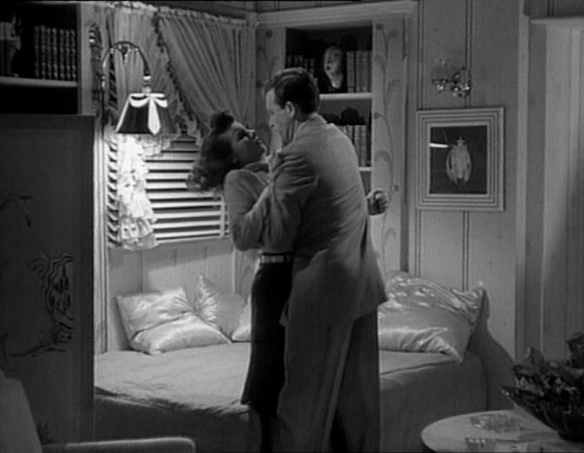
At the risk of inferring too much, I feel that Arnold imbued his character with some of this poetic sadness that he witnessed firsthand. Although he plays Maclain without an ounce of self-pity, the sense of regret that he conveys as he gingerly touches Mrs. Lawry’s face adds to the complexity of his character. He tells her, “You’re just as beautiful as ever. The only time I mind not having eyes is when you’re around.” That instant of melancholy, early in the film, makes Arnold’s portrayal complete. He emerges not as a gimmicky blind detective or as some poster child for not letting a major disability get you down, but as an interesting, quick-witted ex-cop who happens to be blind.

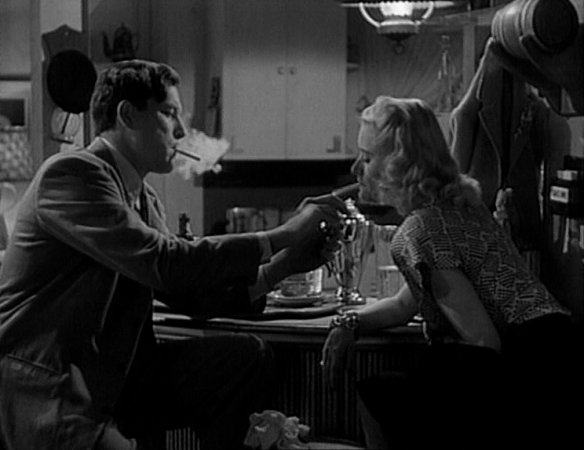
I also enjoyed how Maclain adroitly manipulates and mocks his fascist foes by pretending to be a grotesque stereotype of an infirm, middle-aged man. He insinuates himself into the Lawry house as Mrs. Lawry’s uncle and proceeds to publicly stumble around and even fake a convincing drunk—all in the service of flushing out the baddies. So give this strange MGM B-movie a watch—it’s free, what have you got to lose?—and leave me a comment to let me know what you think!

Click here to watch this film on YouTube or download it at the Internet Archive.

N.B. This movie does contain some unfortunate casual racism in the form of Mantan Moreland as a comical, wide-eyed, offensive African American butler. It’s a shame that this movie, which looks forward in many ways, chose to revert to entrenched tropes for this portrayal.

Beau Brummel (1924): Deeply Superficial

Poster“But the true beau is a beau-ideal, an abstraction substantialized only by the scissors, a concentrated essence of frivolity, infinitely sensitive to his own indulgence, chill as the poles to the indulgences of others; prodigal to his own appetites, never suffering a shilling to escape for the behoof of others; magnanimously mean, ridiculously wise, and contemptibly clever.

Blackwood’s Edinburgh Magazine, 1844.

Superficiality gets a bad rap. After all, what does that much-maligned word denote, in its essence? It means an emphasis on the surface, on that which is readily apparent. Now, I will never condone an obsession with exterior beauty that dismisses any interior value; however, I cannot help but detect something heroic about the desire to project a surface of agonizing perfection. Appearance-consciousness rises to the level of greatness—and dare I say art?—when it demands extreme discipline and taste on the part the person who takes up the heavy burden of being an exalted human spectacle.

I am referring to that hallowed creature, the dandy. And if we want to enjoy Beau Brummel as anything other than a quaintly moving romance based on Clyde Fitch’s 1890 play, we need to introduce ourselves to this most charming phenomenon.

d

The dandy as a cultural and literary concept resists a simple definition. It depends on whom you’re talking to, but I like Nigel Rodgers’s recent definition of “the perennial dandy principles: independence, elegance, courtesy, wit.” On a more philosophical level, the love of my life Charles Baudelaire likened the dandy to the Stoic of antiquity because the dandy wears a mask of whimsy and nonchalance even when in the throes of pain or misfortune or when sullied by the teeming mediocrity of the commercial world around him. His beauty is not vulgar because it cannot be bought merely with money (although it helps, all dandies agree); that beauty reflects his originality, his ability to style and reimagine himself.

And no man incarnated the ideals of dandyism more famously than Beau Brummel, the subject of today’s offering, a 1924 silent period drama based on his spectacular life. (N.B. I am spelling the character’s name Brummel because that’s how it’s written on the titles. However, the favored spelling, according to the junta at dandyism.net. is with two L’s.)

jackprofileBeau Brummel follows the trajectory of a rise and fall. As a young officer, Brummel falls in love with Lady Margery, an heiress betrothed to an aristocrat and fails to rescue her from the clutches of her family.

Deciding to climb the social ladder, Brummel ingratiates himself with the Prince of Wales by getting him out of an amorous jam. Through his careful cultivation of mannerisms and trends and his blistering wit, “Beau” sets him up as the reigning king bee of the upper crust—but earns as many enemies as friends. Eventually, Beau grows too big for his breeches and winds up banished by the Prince to some frigid outpost in Calais, northern France, where he dies in utter penury.

Harry Beaumont, best known for another film about style and appearances, Our Dancing Daughters, directed this poignant tale with panache and an acute eye for stunning compositions and haunting details. In depicting the rise and fall of a fashion arbiter, Beaumont uses mirrors as a motif to explore the character’s self-consciousness. The first shot we see of Brummel is a shot of him between intertitles, reflected in an oval mirror. In that classical round frame, he resembles the immaculate, still images on 18th century cameos. This is the image—but the real man is onscreen, too, although you notice him as an afterthought. We understand that appearance means everything to Brummel. Paradoxically, the most profound desires of his soul express themselves in his drive to be flamboyantly attractive and debonair.

Once Brummel has fallen from grace, the mirror, once his friend, becomes his enemy. Barrymore brought me to tears in one scene where the ravaged, wasted Brummel tries to look at his face then turns away, pushing at the glass with his fingers, streaking it in dismay.

However, I hope that our director, the talented Mr. Beaumont, won’t roll over in his grave if I observe Beau Brummel wears the unmistakable charm and savoir faire of John Barrymore front and center—like a gracefully tied cravat. A rake, a genius, a matinee idol, and as self-destructive a man that ever existed, Barrymore incarnated the sardonic wisdom and reckless hedonism at the core of dandyism.

Our star is also responsible for perhaps this film’s most significant contribution to posterity: Mary Astor’s breakout role.

maryAstor—a woman who never gave herself enough credit for her depth and strength—initially attracted attention from Hollywoodland by winning a beauty contest. Superficiality, at least, brought her to the screen and to all of us. Her possessive parents, so cruel and pushy that they might have easily fit into the ruthlessly upwardly-mobile world of Beau Brummel, recognized her beauty as their cash cow. Mary played several minor parts until John Barrymore asked for her as his leading lady in Beau Brummel.

And that’s when life and art started to intertwine to the point that it would be hard to say which was imitating which. In her autobiography, My Story, Astor recalled her screen test for the role of Lady Margery and her first meeting with the Great Profile:

“We were both in costume of sorts, just enough to indicate the period, and as we were standing in for lighting my awe for this great man made me confused and awkward. Mr. Barrymore broke through my shyness by talking about everything under the sun but the picture; he made me laugh about something, and he gradually and skillfully made me feel that I was his contemporary as an actor and as a person. He told me he had seen a picture of me in a magazine while he was on a train coming out from New York, and the caption had appealed to him: ‘On the brink of womanhood.’ I told him I was seventeen, and he said, just a little sadly, ‘It seems so long ago that I was seventeen. I’m forty now.’

“ ‘That’s not so old,’ I said, and we were great friends.

“I know that on that afternoon we fell in love, and I am sure he was even more startled than I.”

c

Barrymore gave Mary her first acting lessons and unlocked a new realm of ideas and intellect to this affection-starved girl. During some of these lessons, there was no studying, however. These forbidden trysts between the ingénue and the mentor over twice her age echo the roles that they poetically brought to life onscreen. Astor remembered,

“In the filming of the many romantic, delicate love scenes of Beau Brummel we could stand in each other’s arms, Jack in his romantic red and blue hussar uniform and white wig, I in the beautiful Empire style dresses, while the camera and lights were being set. We whispered softly, or just stood there, quietly loving the closeness; and no one was the wiser. Between scenes, Jack had the prop man place two camp chairs together just off the set, and we sat side by side.”

alfredcheneyjohnson

And so, finally, after much perambulation around the film’s contexts, I arrive at Beau Brummel itself. Unlike me, this movie wastes no time; we don’t see the romance between Beau (or George) and Lady Margery blossom—we see it cut off in medias res.

Dressed in her bridal gown, Margery meets her love in the garden to say goodbye to George, a dashing soldier. She’s about to depart for a life bound to another man in a marriage of convenience. Watching Barrymore’s duly celebrated face going nose-to-nose with Mary Astor’s equally photogenic profile presents a sight so stunning and precise it borders on graphic design! I felt like I was looking at one of those dual-profile-chalice illusion sketches.

a

Their dazzling united loveliness might sound like a superficial thing to remark on—but, again, it’s an instance where superficiality weds something more spiritual. The surreal perfection of these two people leads us to wordlessly understand that they are meant to be together. Our eyes know it and our eyes speak directly to our hearts.

Beau Brummel is one of those rare films that captures the spark of an off-screen love affair. You can read it in Astor’s overly wide eyes and in the tender care with which Barrymore’s hands never seem to stop moving, but always seem to nervously long to caress a different part of this splendid creature.

b

Unfortunately, Lady Margery’s nasty, social-climbing mother (not so different from Astor’s real-life maternal unit) bursts in. This harpy forces the girl to choose between her duty and the man she loves—really, no choice, because she can’t exactly run away with an enlisted man. George leaves her in despair, vows to climb the social ladder with his charm and wit. He takes his miniature portrait of her and writes on the back, “This beautiful creature is dead.” We know that he will meet her again.

Mary Astor, even in her teenage years, possessed a striking aura of grief and maturity. For instance, after Beau leaves for France, she clings to the door he just exited through, as if she’d been squashed against it like a broken butterfly. Seen from behind and in a long shot, she communicates a universe of pain merely by wiggling her arms despondently.

1

Except for when she was playing comedy (and even then), Astor interacted with the world as one who has been hurt by it. And with her pale complexion and those perpetual dark circles that even panstick makeup couldn’t conceal, she never looked like she got quite enough sleep. That is a strong part of her allure. You wonder what she was doing all night.

astor2

Both her fragility and her fortitude shine through her portrayal of Lady Margery. Although the script gives her little more to do than watch and react, her wide eyes, so dark that the appearance of the whites is startling, convey a sense of heartbreaking loss. As she turns her eyes to signify the screen direction of her departing lover, we feel her happiness slip away.

trioThe scenes between her and Brummel stand out as the best of the film. Now, that’s not to say that Barrymore doesn’t beguile us pretty much constantly. Whether he’s flirting with another man, treating the Prince of Wales like an inferior acquaintance, or coyly nodding at his jealous fellow officers, he swaggers exquisitely. However, when he encounters the love of his life, then and only then do we perceive the man worthy of all that external beauty.

When Lady Margery visits him in Calais, her youth still shines while Beau, ground down by poverty, has aged horrible. He’s crouched by the fire, gnawing on a piece of bread when she comes in. As she stands in the doorway, yhe awkward stillness of the shot-reverse-shot exchanges tear at our heartstrings. Finally, she enters, informs him that her husband is dead, and, in an unusual inversion of the movie proposal scene, asks him to marry her. Do I smell a happy ending after all? No, alas. As he tells her, “I am grown old, and changed, and tired of life.” After she departs, he starts to sob by the door, biting on his own hand to keep her from hearing and coming back to his aid.

2

Call it vanity, call it stupidity, but he loves her so much that he couldn’t live with the thought of giving her a second-rate version of himself. Thus we witness the pride and integrity that sustains dandyism. We also observe a very genuine facet of Barrymore’s love for his teenage costar.

russelbail

As Astor noted, “I know Jack loved me. I know it as surely as I know the fact of my own existence. Fifteen years afterwards he was talking to me about it, telling me how surprised he had been to find himself beginning to love me that first day on the Beau  Brummel set. Even then, fifteen years later, he didn’t dismiss it lightly. ‘It s a good thing I wasn’t free to marry,” he said then. ‘And it’s a good thing I couldn’t get you away from your family. I would have married you, and you would have had a miserable life.’”

bgIf that scene doesn’t wet your cheeks, wait until the last act, which finds Beau in a debtor’s hospital as a decrepit, crazy old man. His former servant visits him with the news that Margery is dying.

This news penetrates Beau’s senility and he begins to relive his best days with her. Cut to Margery in her bed. She breathes her last… and her splendid spirit rises from the bed. Her superimposed soul descends into Beau’s squalid room just as he expires. And he too emerges from his mortal coil as the idealized officer he once was.

Why is it that our souls are supposed to look like ourselves—but in the prime of life, at our youthful pinnacle? Are we being superficial? Or perhaps we associate that beauty with hope and with the time in our existence when we still aspired to something.

As the ghostly Lady Margery and Beau embrace, the shimmering schmaltziness of this telepathic love-beyond-life scenario actually works and triggers a surge of weepy fulfillment. The visual pleasure of gazing at such picturesque people and the verisimilitude of the actor’s star-crossed love affair succeeds at provoking catharsis. After all, cinema is sort of a dandy; like Brummel, this art of surfaces runs surprisingly deep. It can see the veracity and purity of love that no one else could. And preserve that love for almost 90 years.

astorthon3-1

Free Friday Film: The Ghost Camera (1933)

5

Are you up for a quickie? No, not that kind. Wash your brain out with soap, you n’er-do-well. Today I’m tempting you with a quota quickie, a cheaply produced British B movie produced to satisfy English law.

In 1927, the Cinematographic Films Act required British movie theaters to exhibit a certain percentage (it rose to 20%) of British-made films in an attempt to lessen the influence of American culture, pouring into England through Hollywood films, like the Spanish Armada in celluloid form. Well, tempted by the guaranteed opportunity to have their films shown in cinemas, British studios churned out movies with insanely small budgets—about 1 pound per foot of film, according to the UK Guardian.

Rather like Poverty Row films, many of these quota quickies stank like gone-off Vegimite. However, plenty of them also offered burgeoning directors and actors Michael Powell, Errol Flynn, Vivien Leigh, and Ann Todd a chance to cut their teeth on their first cinematic experiences. And, what with necessity being the Queen Mum of invention, many quickies display creative stylistics and wacky plots—to cover up their budgetary shortages.

4

It breaks my heart to inform you that 60% of these movies are considered lost. But Martin Scorsese and the BFI are actively hunting for them. As it is, more and more of these are available on DVD and hopefully we’ll get a full-on quickie festival someday. Wait, that came out wrong…

So, in my usual roundabout way, I come to today’s sacrifice, The Ghost Camera, a 1933 mystery from debut director Bernard Vorhaus, a talented fellow whose Hollywood career was cut short by the blacklist. This entertaining, plot-packed thriller clocks in at about an hour, a refreshing feat in comparison to the bloated two-going-on-three hours spectacles that are showing at a movie theater near you nowadays.

The story follows John Gray (Henry Kendall), a bespectacled, preening intellectual who arrives home from his vacation to discover that someone dropped a camera in his luggage. Deciding to develop a picture in hopes of returning the camera to its owner, our hero discovers—gasp—a picture of a murder!

3

Before he can show the image to the police, though, someone nicks it, but leaves the amateur detective with the camera and the remaining undeveloped negatives within. Piqued by the theft and up for an adventure, Gray decides to retrace the photographer’s steps by tracking down the locations where the pictures in the camera were taken. In the process, he meets the camera owner’s troubled sister, Mary Elton, stumbles across a jewel heist, and finally roots out the killer.

As with many quota quickies, The Ghost Camera gives us a glimpse into the before-they-were-famous careers of big names in cinema history. A charmingly baby-faced Ida Lupino graces the screen with her discreet magnetism as Mary, the lady in distress. As she accompanies the sleuth, she both seeks and dreads the truth about her brother and his camera.

6

Unfortunately, the print of this film available on YouTube looks like it was strained through cheesecloth (which is why I didn’t pepper this post with screencaps). Nevertheless, the cinematography does shine. The director of photography, Oscar-winner Ernest Palmer, an American, shot the melodically lovely Borzage films Street Angel and Seventh Heaven, so it’s no surprise that he pulls out some bizarre visual poetry even for this cheapie. The scenes in the darkroom, almost total blackness except for a few starkly-lit faces, convey a spooky sense of dread that foreshadows the virtuoso lighting contrasts of mature British noir. Again, when the protagonist investigates an abandoned, ruined fortress, darkness prevails, plunging us viewers into a situation where we must stay riveted to the screen for the slightest flash of light or sound to know what’s going on.

Best of all, the great David Lean earned one of his first screen credits on this film as an editor. He later acknowledged director Bernard Vorhaus as a formative influence on his career. Indeed, combined with the cinematography, the editing here can only be described as audacious. For example, the movie starts with a low angle shot of a looming castle keep. The camera slowly tilts down and pans to a car on the road. Jump cut to the vine-covered walls of the ruin. Jump cut to the backseat of the car into which a camera tumbles. Where did it come from? Who dropped or threw it? Did the car pick it up on purpose or is the driver totally unaware? This pre-credit sequence leaves us intrigued, tantalized. Exactly what you desire from a mystery thriller!

2 1

The first time I watched The Ghost Camera, its visual flamboyance stunned me. Shaky handheld motions, jump cuts, swish pans, and disorienting shifts of focus: you’ll see a lot of things here that we tend to associate with the “groundbreaking” movies of mature European art cinema, especially French New Wave. The jarring, unstable camerawork also awakens the audience to the foibles and strangeness of mechanical recording. That is, we realize that we’re watching a movie, a reality filtered through a camera.

The camera as a recording instrument itself carries an uncanny aura. Think about how many meta-thrillers and horror films revolve around some variation of a ghostly, anxiety-inducing camera or pictures: The Big Sleep, Blow-Up, Chinatown, and The Eyes of Laura Mars, to name a few. The Ghost Camera actually amplifies its slapdash, B-movie discontinuity, its jerky camera movements and warping perspective, to generate fear. The movie camera takes on a life of its own. Meanwhile, the film’s plot, in which developed images serve as clues, shows us how photography’s special bond with reality can bear an alarming witness.

The camera’s truth speaks in tongues, though—as the weird, vertiginous cinematography of The Ghost Camera suggests—that need to be interpreted by human reasoning.

11

Mix all this innovative flair and love for the filmic medium with a droll script, really a parody of the whodunit, and you have a beguiling hour’s entertainment. Our mewling hero John Gray continuously treats us to his pessimistic, helpless commentaries. For instance,

“I really don’t know why I continue to go on holidays, Simms. They’re never adventurous. Just the usual people and happenings, unexciting, like myself. Man is an irrational animal, Simms, persisting to hope for what his reason has proven nonexistent.”

At another vexing moment, he humorously exclaims, “Oh but this is absurd! We’re beginning to talk like characters in a mystery melodrama.” If only he knew…

So, watch The Ghost Camera and celebrate this testament to what wonderful popular art a bunch of clever people can cobble together out of basically nothing. It’s certainly one of the most enduring and satisfying quickies you’ll ever enjoy. Click here to watch the film on YouTube.

N.B. I learned about the history of the quota quickie from these thoughtful sources. I didn’t pull those facts out of thin air and I gratefully and fully acknowledge these articles and their authors for their research and insights. I’m citing them informally, because this is a blog post, not a college paper!

“Fancy a Quickie?” by Matthew Sweet from U.K. Guardian Monday, 1 January 2007.

“In Praise of the Quota.” at British Pictures Article Archive.

Costume Ball: I’m Hosting #MTOS This Sunday!

moroccoThis Sunday, May 5, I will have the honor of hosting Movie Talk on Sunday for the second time! In case you’ve never heard of #MTOS, it’s an engaging Twitter discussion for all cinephiles that happens once a week.

People from around the world turn out, so the mix of viewpoints promises a variety of insights and lots of fun. (It was so much fun last time I hosted that I ended up in Twitter jail! Attica! Attica!) I hope that you, dear reader, will join in and add your responses to the conversation.

I chose film costumes as my topic, because, let’s face it, they’re fun to talk about! And, unlike many elements of cinematic language, clothes are something we all know something about, don’t we? We wear our identity in our clothes, our daily version of costumes. We’re also in the habit of decoding other people’s clothing to figure out who they are. (Unless you live naked on a private island, in which case, that too is a distinct fashion statement.)

scarlettToo often overlooked in film analyses, costumes shape our perceptions of characters and their relationships. As in the case of the infamous “shopping montage” cliché, whole scenes may revolve around costumes. Iconic articles of clothing help us recognize genres: can you imagine classic film noir without the trenchcoat and the Fedora? Or a Western without jeans and the cowboy hat? Whether we’re aware of it or not, costume colors, textures, sometimes even the sounds they make also enrich the aesthetics of any given movie and deserve greater scrutiny.

So, to slip into something more comfortable, here are the questions: 

1. To get started, which film costume impressed you and stayed with you most vividly?

2. Costumes can be used to transform a character or signify how they’ve changed. Which film has done this well?

3. Which director, in your opinion, has made the best use of costumes to enhance the look and style of his/her films?

4. Costumes sometimes serve to contrast characters through their different clothing styles. What’s a movie that has done this well?

5. The power of costuming can work for comic effect. What’s a movie outfit that added to the humor of a scene or made you laugh?

6. What’s a good example of a costume (or accessory) that serves as a key plot point in a film?

7a. Which male movie character has the best/coolest wardrobe?

7b. Which female character?

8. Which movie star’s image is most associated with their costumes they wear (or wore)?

9. Has a film’s costuming ever really disappointed you? Which movie and why?

10. Have you ever copied a movie character’s style? How did that work out for you?

Put on your Sunday best and join the costume ball on May 5! 

charade

Free Friday Film: Dark Journey (1937)

poster

In order to explain the plot of Dark Journey fully, I would need to make a diagram. Which is why I’ll spare us all and just tell you to watch it.

If the plot of this 1937 British espionage thriller leaves us in the dark, its resplendent romance rises to the occasion and lights the way through. Best of all, Victor Saville’s stylish movie manages to convey the individual stakes of spying in wartime far more effectively than most pre-WWII secret agent yarns I’ve seen.

Under the gloss of their anachronistic settings and costumes, Vivien Leigh and Conrad Veidt communicate the exhaustion and anxiety of two people constantly on guard, constantly assessing the risks and rewards of their actions and affections.

8

Despite the fact that the story takes place during World War I, the producers made absolutely no attempt to recreate the fashions and ambiance of that period. Right there, the eye is confused: it’s hard to keep telling yourself that the events of Dark Journey are unfolding in 1918 when the cast appears to have sought refuge from one of Wallis Simpson’s house parties. I would usually object, but I find this cavalier attitude towards verisimilitude rather charming. I guess, you can never predict what I’ll find charming, but usually it involves Art Deco in some way.

21

“My monocle is very displeased!”

11

“And now my monocle is intrigued…”

And speaking of charming, Veidt looks better than ever in a monocle and a tuxedo that shows of his impeccable waist—only slightly larger in circumference than that of his exquisite co-star. Vivien Leigh, in her sixth movie and one of her first true leading roles, musters an extraordinary performance so subtle that, in comparison to her Scarlett O’Hara, it could be mistaken for somnambulism. She carries her much-remarked-on porcelain beauty like a mask that only occasionally allows a crease of genuine reaction to be perceived.

34

Be forewarned: from here on in, this post does contain major spoilers. However, I would also note that about 25 minutes into this film, I was searching for spoilers on the Internet, the film had confused me so. IMDb gives the following tagline: During World War I, a German spy and a British spy meet and fall in love. Okay, fair enough, except that I kept wondering which character was spying for whom. On the surface, it seemed obvious, after all, Viv is English and Connie is German.

24

But wait! Our Viv plays Madeleine Goddard, a Swiss dress shop proprietor living in Sweden who practically commutes back and forth from Paris, importing the newest French fashions with her. With each trip, she brings more with her than the latest modes: military information sewn into the fabric. We discover this when she attends a clandestine meeting of vaguely sinister middle-aged blokes and proceeds to decipher a dress by holding it up to a lampshade with a map pattern.

2928

From there, one of her confederates signals the defense information to a boat which then conveys it to… BERLIN?

What!?! Vivien? The so-British-she-was-born-in-India Viv of That Hamilton Woman as a German spy? The mind reels at the thought, even if she is playing a Swiss girl. Or is she?

Meanwhile, the first time we see Conrad Veidt, probably best known as the wicked Major Strasser, he’s not engaged in espionage for the Fatherland. His Baron Von Marwitz is running away from the Fatherland! As he wryly informs a customs agent, “I came to Sweden because I want to refrain from any political activity.”

So, I ask myself, is this deserter going to start spying for the British while she’s spying for the Germans? Well, no. Just wait and see.

19 16

The graceful aristocrat indulges himself in Stockholm, establishing his reputation as a bon vivant with a special trick: he can tell what any girl will say after he’s kissed her. Madeleine sees him playing this parlor game at a nightclub and blows his secret: there are only a few likely things a girl would say, and he keeps all them in some part of his clothing, only to reach for the correct one when the time comes and act like he thought of it beforehand. Don’t ask.

Enchanted by Madeleine’s brains (and the fact that she has Vivien Leigh’s face), Von Marwitz pursues the girl, seemingly unaware of her extracurricular activities. Their love affair unfolds with a mixture of passion and fear, fascination and hostility, as we detect in their earliest exchanges:

Marwitz: Why did you give away my little trick last night?

Madeleine: Because you claim to know so much about women.

Marwitz: I know nothing about them.

Madeleine: That means that you’ve had a lot of experience.

Marwitz: Oh, a lot. But what does it amount to?

Madeleine (giving him the bill for the dresses he just bought for some tarty girl): One thousand two hundred and seventy-five krona.

But back to the intrigue: When Madeleine’s superior agents order her to Paris, then and only then, more than halfway into the film, did I learn that she’s actually a double agent. She passes on select information to the Germans for the strategic benefit of the French and the British.

6

However, no sooner do we find this out than does Marwitz… who’s actually the hidden mastermind behind the German Secret Service cell in Stockholm. Head spinning yet?

The final third of Dark Journey shines most brightly, once the characters have put their cards on the table and the situation is handled for suspense rather than surprise. In the astonishing scene when Madeleine figures out Marwitz’s identity, they lock in one of the slowest, most poetic movie kisses I’ve ever seen. Madeleine clings to him as he lifts her slightly—like a ballet in smooch-form.

56 54 53

Veidt and Leigh possess a strange chemistry that churns mightily, like the waves of the North Atlantic, an image that dominates Dark Journey. The two enigmas collide. Under his hedonistic façade, there’s a core of austere courage and beneath her schoolgirl manners, she harbors the fierce strength of a career woman and a spy. Their relationship buzzes with the electrical charge that comes from two equals, two foes joined in a dangerous embrace. Shades of Garbo and Gilbert!

4

50

Throughout the frenetic following scenes, I found myself wringing my hands in dread over what’s to become of Madeleine, as she now rushes to flee the country and escape from her beloved who must do his duty and try to have her killed.

In one particularly lovely scene at the end, once she’s been smuggled onto a ship leaving Sweden, Leigh’s performance suggests the natural emotions that one would feel: the simultaneous relief (I’m safe now…) and apprehension (…safe for the moment). However, she also adds a layer of more perverse sentiments—we understand that she wants Marwitz to abduct her because that would mean that he is indeed a daring patriot and also a passionate lover. In her mind, he’s part Siegfried, part enemy agent. Ironically, only by trying to drag her to her execution can Marwitz prove an ideal romantic partner. We perceive the barest glint of excitement in her eyes when she hears the ship being boarded.

45 44 43

In the “Dolce” section of Irene Nemirovsky’s haunting WWII novel, Suite Française, a German officer, engaged in a forbidden romance with a French woman, compares the anticipation inherent in war and in love, observing that “Waiting is erotic.” Dark Journey captivated me with this atmosphere of waiting, of imminence. Fans of a good star-crossed love story won’t be steered wrong with this one.

41

The script provides many piquant morsels of dialogue from Arthur Wimperis, whose dry wit enlivened Mrs. Miniver and A Knight Without Armor, and Lajos Biró, the brilliant scenarist behind Alexander Korda’s historical “private lives” films. I enjoyed the banter between Madeleine’s squabbling saleswomen, one German, one French, whose daily backbiting reveals the ultimate pettiness of war and nationalism. As Madeleine finally tells them, “I do not want French women here… nor German women. I want saleswomen!”

32

“Stop playing League of Nations and take care of the customers, you hussies!”

Madeleine’s crotchety, lazy storekeeper, Anatole also gets some amusing, but very un-Continental lines. While trying to make his excuses for not sweeping the floor, he kvetches, “What can one do with a broom that’s as bare as the behind of the burgermaster’s baby?”

My absolute favorite line, however, comes from the mouth of a bit player—why do bit players get the best lines in British films? One of Von Marwitz’s servants is bemoaning the Baron’s infatuation with Madeleine which prompts him to buy up all of her dresses as an excuse to see her: “It used to be all girls with no clothes. Now it’s all clothes with no girls.” What’s the 1930s equivalent of LMAO?

18

Shot by world-class cinematographers George Périnal (of Colonel Blimp and The Fallen Idol) and Harry Stradling Sr. (of Suspicion and My Fair Lady), Dark Journey paints a glamorous world with undercurrents of surreal dread. From the claustrophobic halls of steamer ships—threatened by torpedoes—to the chic expanses of posh nightclubs, this film offers us an entertaining portal into Europe on the brink of World War II.

Watch Dark Journey. You may be utterly befuddled by the plot. But, if you’re like me, you’ll be too entranced to care.

To watch the movie on YouTube, click here.

And because they’re both so beautiful, here are some gratuitous screencaps of Vivien and Connie. 14 40 46 57

48 20 17 3

Hamlet (1948): Spacing Out

Screen Shot 2013-03-30 at 5.24.45 PM

It’s not hard to understand why Laurence Olivier selected this abbreviated passage of Hamlet as the opening statement, the thesis, if you will, of his adaptation. After all, these few lines contain the most eloquent description of the tragic flaw that anyone ever wrote; well, duh, it’s practically Shakespeare analyzing Shakespeare. If anything, the quotation slaps us across the face with its significance. We might even feel inclined to groan at its 9th-grade-English-class heavy-handedness, spliced right into the exposition of the film. But we would be wrong to do so, because it contains the central image of Olivier’s brazenly stripped-down vision of the literary masterpiece.

Screen Shot 2013-03-30 at 5.59.01 PM

The last time I watched this movie, a line from the epigram tickled my brain: “Oft breaking down the pales and forts of reason.” Because, what is “reason” if not a buffer, a barrier? Something that restricts our mind like a corset of scruples and holds it prisoner like a castle keep? Reason consists series of bulwarks that we erect between ourselves and madness in all of its forms, whether excessive melancholy, anger, or desire.

Screen Shot 2013-03-30 at 6.41.41 PM

The nature of reason expresses itself in architectural terms, particularly medieval ones. We live inside our heads, besieged by armies of competing facts and moral codes, and probably lift the portcullis of perceptions and prejudices much less frequently than we think we do. Okay, so I’ve over-extended my metaphor, but in the service of Olivier’s direction. His Hamlet seizes on that guiding conceit, the fortress of reason, and spins it into a space where Desmond Dickinson’s camera seems to ruminate like Hamlet’s troubled mind, forever roving and wandering.

The opening of Olivier’s Hamlet freezes time. No one moves, like they couldn’t even if they wanted to. Four men stand on the ramparts of a castle, bearing the Prince’s corpse. We begin at the end of the story, which, though this isn’t exactly a spoiler, infuses the film with distinct a sense of dread.

Screen Shot 2013-03-30 at 5.25.43 PM Screen Shot 2013-03-30 at 5.26.01 PM

But what fascinates me about this opening shot is how time seems to have stopped, but the camera glides through air, arcing out of the fog towards the prince’s body. The camera shows us that while time might have stopped for the people of this tale, the dimension of space remains open—and the camera dances in it. The contrast between still, inert humans and a living, moving perspective divorced from them, well, it spooks me. It’s like the visual translation of the alarming question that begins Shakespeare’s play, “Who’s there?” Who—or what—is swooping down to look at the funerary procession while mortals don’t budge?

The next shot flips me out even more. On that forbidding castle fort, those figures in mourning just dissolve into thin air. Apart from the fact that this dissolve reminds us of how easily we all eventually dematerialize, it also reveals the film’s conception of space as a psychological entity. This Elsinore, which initially appears to have been lifted from a book of Charles Lamb’s tales or a Horace Walpole novel, actually exists in a place between Hamlet’s imagination and reality. The castle, though real, occasionally bleeds into the fortress of Hamlet’s askew reason.

Screen Shot 2013-03-30 at 5.26.25 PM Screen Shot 2013-03-30 at 5.26.38 PM

Nowhere is this link more clear than in Olivier’s staging of the play’s most famous monologue. Immediately after Hamlet rejects Ophelia for betraying him, the camera wooshes out of the room, up a staircase, and goes on one of its freak-outs, travelling up flight after flight of stairs—or actually, the same flight of stairs, cut together again and again.

Finally, the camera flies up to the sea, seen from the top of the castle, and then a track-back brings Hamlet’s head into sight from the bottom the frame. For my money, those M.C. Escher-ish repeated staircases convey the structure of rumination, of those repetitive thoughts that we can’t quite break away from. Hamlet’s mind is a lively, circular one, forever walking up and down the gloomy staircases of the Big Questions: why do we live? And is it worth it?

Screen Shot 2013-03-30 at 6.38.07 PM Screen Shot 2013-03-30 at 6.38.29 PM Screen Shot 2013-03-30 at 6.39.07 PM

That sudden emergence of Hamlet’s head on the screen always surprises me a little. After a dissociative fit where we almost loose any sense of proportion on those abstracted staircases, we’ve returned to a man as the point of reference. Hamlet’s “problem,” in my humble opinion, is that the universe as a whole speaks to him.

He realizes his insignificance in the grand scheme of things; he cannot act because he questions the usefulness of any action at all. Hamlet combines self-absorption with self-effacement. He swims in the frightening space of the cosmos and wriggles in the prison of his own duties and life. That crane shot returning to the melancholy prince suggests this push-pull, this paradoxical feeling that Hamlet at once too much inside himself and too far away from himself.

Screen Shot 2013-03-30 at 6.40.04 PM

I love how Elsinore’s spaces reflect emotional nuances that a stage never could. For instance, the first crane shot down to focus on Hamlet after his introduction cements our identification with him, with the thinker, the man left alone in the debris of pompous court ceremonies.

Screen Shot 2013-03-30 at 5.39.27 PM Screen Shot 2013-03-30 at 5.39.39 PM Screen Shot 2013-03-30 at 5.39.50 PM

Or consider how the long corridors of arches create a pathetic reciprocal gaze between Ophelia and Hamlet. The hallway inscribes their confused desire in stone.

Screen Shot 2013-03-30 at 5.45.21 PM Screen Shot 2013-03-30 at 5.44.58 PM

Likewise, I treasure Olivier’s pirouette in the performance hall of Elsinore, shown in a long shot, as he exults, “The play’s the thing wherein I’ll catch the conscience of the King!” In his book On Acting, Olivier described Hamlet as the sort of person who needs to enter into someone else’s skin to get anything done: “it’s a sporadic collection of self-dramatizations in which he always tries to play the hero and, in truth, feels ill-cast in the part.”

Screen Shot 2013-03-30 at 6.46.35 PM

His ecstasy in a performance space exposes how he yearns to escape his limitations—and in the cavernous great room, the euphoria of that small gesticulating figure rings false. That desperate spurt of joy that Hamlet feels on that empty stage space, play-acting only for himself, paints a sad portrait of this man who considers himself unfit for everything others expect from him. Unlike Laertes and Fortinbras who never doubt their capabilities, Hamlet mercilessly beats up on his character flaws. If anything, his flaw is that he’s too aware of his flaws.

In 1988, two psychologists Taylor and Brown, found out something that Shakespeare’s Hamlet had been telling us for a long time. Namely, that people suffering from mild depression are far more in touch with the reality of life and death than normal, healthy individuals who think that they’re better, smarter, and safer than the “average person.” Hamlet lacks the survival prejudices that would have allowed him to filter out all the reasons not to act, not to stay alive. He sees the world with depressive clarity: “nothing’s either good or bad, but thinking makes it so.”

Screen Shot 2013-03-30 at 5.57.34 PM Screen Shot 2013-03-30 at 5.58.02 PM

So, indeed, reason consists of “pales and forts.” Reason usually provides a structure that protects us from ourselves and we live inside it, like happy guests in a castle, until something goes wrong, something that lets us understand that we are not immune to ugliness and pain. Like Hamlet pulling back the arras to see that he has killed the wrong man, one who sees the world as it is howls at the brutal disillusionment. And then all that reason turns from a bulwark to a prison. Reason and logic then start to encircle us with worries and perspectives that unhinge the unity of mind that one needs to do anything.

As Hamlet walks among the arches and pediments of Elsinore, he moves freely, but the walls close in upon him, pillars fragment the screen and crowd him. Unlike Ophelia, who in her craziness finds a state of mind akin to freedom and who drowns outside the castle walls, Hamlet struggles within them. The castle echoes back his angst—as does the Ghost, whose voice is actually a slowed-down recording of Olivier.

Screen Shot 2013-03-30 at 5.54.41 PM

Only imminent death, as Olivier notes, added the final ingredient to Hamlet’s character that enabled him to act. His own self-destruction fueled a newly personal need for retribution; he could kill the king only because he himself was dying.

Screen Shot 2013-03-30 at 7.41.52 PMAfter Hamlet dies, the camera pan’s to the region of darkness behind the chair where his head rests, as if in mourning for the blackout of his exquisite consciousness.

Screen Shot 2013-03-30 at 7.42.10 PM

In death, Hamlet still lies inside the ramparts of reason; the film ends where it began, but with a crucial shift. As the same four men seen at the beginning of the film carry the prince to the top of the castle, the camera snakes past the vestiges of the things that once preoccupied Hamlet: his place in court, the incestuous marriage bed, and a Christian altar. The men bear his body up the stairs to the top of the castle, where he meditated on his own mortality, and the camera swings back. We experience a solemn elevation and a swelling fondness for the “sweet prince,” whose real kingdom was a state of mind. Not only did he accomplish his goal, he possessed that noblest and rarest of qualities: unflinching insight.

Screen Shot 2013-03-30 at 7.52.54 PM Screen Shot 2013-03-30 at 7.53.08 PM Screen Shot 2013-03-30 at 7.54.16 PM

The innovative spaces of Olivier’s Hamlet tap into the unique capacities of cinematic language. They transcend the glibness of symbolism, of “this equals that” imagery. Instead, the way the camera creeps around the architecture of Elsinore enables us to penetrate into what the intellectual Hamlet actually feels. The amorphous, psychological film-spaces blazed the trail for art films like Blow-Up (I’m thinking especially of that final enigmatic dissolve), Last Year at Marienbad, and The Shining, to name just a few.

But, most of all, the film’s benighted rooms and fortifications enable us to witness the birth of a modern man, banging his head against the illusions implicit in normalcy and order. The dread of mortality and failure may paralyze Hamlet. Yet, his greatness, his heroism, the reason why we weep for him resides in the very flaw that forestalls him: his sensitivity, his intensified sentience. The flexibility of the camera’s movements transmits the remarkable agility of his mind and the diversity of opinions that contend in his spirit. He would probably have been a terrible king, but he was a sublime human being.

Screen Shot 2013-03-30 at 7.33.06 PM

Whistling in the Dark: His Girl Friday (1940)

posterThe Mayor: Whistling in the dark. Well that isn’t going to help you this time. You’re through. 

Walter Burns: Listen, the last man that said that to me was Archie Leach just a week before he cut his throat.

Fresh. Exhilarating. Spontaneous. Timeless. These are often the words that come up when people talk about Howard Hawks’s His Girl Friday, a movie closer to perfection than pretty much any other movie ever made. Well, today, I’m going to add a few more adjectives to the pot: morbid, noirish, and iconoclastic. And I meant that as the highest of compliments.

Upon a recent rewatching of this sublime screwball comedy, the inherent darkness of the film practically slapped me across the face. I mean, you try going into a producer’s office these days and pitching a comedy about capital punishment.

Screen Shot 2013-04-18 at 10.45.22 PM

The Angel of Death looms over this fast-paced comedy, which teaches us that humor often works best when we’re all in the jittery throes of nervous laughter. Yet, even beyond the morbidity of Earl William’s fate, His Girl Friday revolves around the ideas of freedom—and imprisonment. Or, more precisely, the uneasy balance between those two things in a person’s life. If, in the end, Hildy escapes the prison of a stuffy marriage, she doesn’t get Freedom-with-a-capital-F, but rather, a more wonderful kind of captivity, an enslavement to her passions and her talent.

Screen Shot 2013-04-18 at 9.33.26 PM

Screen Shot 2013-04-18 at 9.25.37 PM

Earl Williams escapes death and Hildy escapes from dull matrimony. The parallel can’t be avoided. In fact, the movie serves that similarity up—Hildy wears it on her sleeve. Hildy’s wardrobe is characterized by an assortment of lines and stripes, which suggest the blend of playful and professional in her demeanor.

However, when she visits the prison, those stripes on the trim suit she wears to get her interview don’t resemble anything so much as prison bars. In fact, the straight lines (unlike the zig-zags she wears in the earlier scenes) are almost exactly parallel to the low-key lit shadows of the iron bars.

Screen Shot 2013-04-18 at 10.52.10 PM

Throughout His Girl Friday, Hawks scatters a few shots that let us, the viewers, bask in the kind of importance that Hildy feels in her natural habitat, the newspaper world. As she breezes through the newsroom, a point-of-view tracking shot scans the smiling faces of her impressed colleagues, looking up at her.

Screen Shot 2013-04-18 at 9.16.53 PM Screen Shot 2013-04-18 at 10.42.40 PM

Later, when she visits the pressroom, her voice announces her presence from off-screen and all those sacrilegious monkeys of the press, suddenly turn her way, their face filled with admiration and a plausible substitute for respect. In other words, His Girl Friday sneaks in the occasional subjective shot, designed to make us understand what Hildy feels as the sob sister in the band of brothers.

But in the jail, we get a very different shift to Hildy’s perspective, a more metaphorical one.  She’s sitting outside William’s little pen and asking him questions. We’re on her side of the grate, looking in at Williams. And then this exchange happens:

Earl Williams: I’m not guilty. It’s just… the world.

Hildy Johnson: I see what you mean.

In between those two lines of dialogue, as Hildy passes Williams her cigarette, there’s a cut that puts the camera on the inside of the cage. Suddenly, as Hildy agrees with Williams, it visually seems as though she’s the one behind bars.

Screen Shot 2013-04-18 at 10.53.34 PM Screen Shot 2013-04-18 at 10.53.52 PM

Now, it’s not a point-of-view shot, however, I felt a major change in the stakes of the scene at that point. This isn’t just another story for Hildy: it’s her last. This isn’t just another day for Williams: it’s his last. We sense a true bond between the pair of them as Hildy slips him her cigarette: at that moment, they are both the condemned, in a way.

Screen Shot 2013-04-18 at 11.07.12 PM

As much as Hildy only needs to wring a story out of the prisoner, I can’t help but feel that the stylish lady journalist really does identify with his confusion. I mean, we get the feeling that her engagement to Bruce sort of happened to her. Does she want a man who will really take care of her? Well, yes, but I also can’t help but assume that Hildy’s sudden bolt to the altar reflects the influence of society, the pressure to live a normal woman’s life. Staring into skull-eyes of another man’s fate, Hildy actually catches a glimpse of her own.

Screen Shot 2013-04-18 at 9.44.50 PM

His Girl Friday presents us with three different couples: Hildy and Bruce, Hildy and Walter, and Molly Malloy and Earl Williams. We first see the first pair exchanging syrupy love dialogue: they demonstrate the somnambulism of domesticated love. Molly and Earl Williams obsess over each other with doomed passion—it’s like we’re watching a mini film noir embedded in a screwball comedy. Both extremes strike us as imprisoning relationships that incapacitate the characters. Only Walter and Hildy seem able to skip around each other and have fun in a dance of freedom and constraint.

Screen Shot 2013-04-18 at 9.15.17 PM

Screen Shot 2013-04-18 at 11.10.05 PM

Screen Shot 2013-04-18 at 11.26.48 PM

Quick quiz: which of these relationships do you want?

I love His Girl Friday for many reasons—the Syd-Field-defying length of many of its scenes and the overlapping dialogue, for instance—but mostly because I want to be Hildy Johnson. Because her love-on-the-go for Walter (and vice-versa) is one of the most unconventional romantic relationships portrayed on the classic Hollywood screen.

Even in the wackiest screwball comedies (as in Shakespeare plays), the story usually ends with the hint that the adventure is over. You can go home now, folks!  Harlequin and Columbine have overcome their obstacles and they’re going to settle down and have babies now.

Screen Shot 2013-04-18 at 9.29.35 PM

“I don’t care about your biological clock! This is a HOWARD HAWKS movie!”

His Girl Friday skirts this frozen conclusion. It overturns the belief that love brings about an end to adventure. A topsy-turvy attitude towards marriage crackles in the humorous inversions of its dialogue, as in Walter’s mock-lamentation about how divorce has lost its meaning:

“You’ve got an old fashioned idea divorce is something that lasts forever, ’til death do us part. Why divorce doesn’t mean anything nowadays, Hildy, just a few words mumbled over you by a judge.”

It laughs at all the parlor-piano-with-a-doily-on-top values that most movies were selling hard in 1940s. Thank God.

Screen Shot 2013-04-18 at 11.32.49 PM

Okay, so now that I’ve worked all that analytical rubbish out of my system, let’s get right to the Cary Grant appreciation. That man made acting look so easy that it hardly surprises me that he never won an Academy Award.

Screen Shot 2013-04-18 at 9.22.37 PM

If you watch The Front Page (His Girl Friday is a remake), you’ll notice that it’s actually a much more visually flamboyant film. There are mirrored-corridors, flashy crane shots, and more conspicuous arrangements of light and shadow to hold your attention.

But His Girl Friday more than made up for all of that lost razzle-dazzle with Cary Grant’s roguish pyrotechnics. Whether he’s imitating Hildy’s pre-marital flirting (“Oh, Walter,” he coos, with a fey flutter of eyelashes), pouring water on his own pants a ruse, or leading Bruce in a guided visualization of Hildy’s old age, Grant’s energy floweth over.

Screen Shot 2013-04-18 at 9.30.25 PM

Screen Shot 2013-04-18 at 10.49.25 PM

He’s a marvel to watch, like a supernova in a double-breasted suit. And his dimple deserved supporting player billing. It even gets mentioned in the dialogue.

Hildy: A big fat lummox like you hiring an airplane to write: “Hildy, don’t be hasty. Remember my dimple. Walter.” Delayed our divorce 20 minutes while the judge went out and watched it.

Walter: Well, I don’t mean to brag, but I’ve still got the dimple, and in the same place.

Tying into the black humor of His Girl Friday, Cary Grant gave us one of cinema’s most celebrated in-jokes by turning his own identity into a gag. I wonder, did Archie Leach have to “cut his throat” for Cary Grant to be born?

Screen Shot 2013-04-18 at 11.48.08 PM

And Rosalind Russell, who famously got the role only after Jean Arthur, Carole Lombard, Ginger Rogers, Claudette Colbert, and Irene Dunne weren’t available, shows them all up with her brilliant performance. I have a hard time picturing Claudette Colbert (or any of the other fabulous Hildy candidates) camped out in a coal mine or stealing a stomach preserved in formaldehyde from a city morgue. At least, she’d still be perfectly gorgeous and innately graceful while doing so.

As a recovering comedienne, I admire how Russell embraces Hildy’s anything-for-the-story mentality. Her clumsy rush to cross a street as a police motorcade whooshes past her, hollering at the top of her lungs, stands out as one of my favorite moments in the film.

Screen Shot 2013-04-18 at 11.05.32 PM

Russell, however, dives into the character of Hildy like Hildy would into a dumpster. Chucking her purse at her ex-hubby and answering several phones at once, she displays a valiant klutziness that every woman can recognize in herself. We can believe this woman as the kind of tough but goofy broad that can and does win the grudging respect of a pack of self-absorbed dudes.

Screen Shot 2013-04-18 at 11.53.17 PM

The shyster and the sob sister belong together—whether they’re physically handcuffed together or just bound to each other by sarcasm and desire and the great puffs of smoke that they exhale at the same time. The glee of their rivalry teaches us that while love doesn’t necessarily give you a get-out-of-jail-free card, it should never make you feel like you’re behind bars.

Marriage is growing old together. Love never grows old. Like this movie. Now, that’s as corny as Iowa, but that doesn’t make it any less true.

Screen Shot 2013-04-18 at 11.01.32 PM

I’d like to smooch the idiot who let this movie slip into the Public Domain. Watch it on YouTube or download it for free at the Internet Archive. So, my Free Film Friday is His Girl Friday. How appropriate is that?

Oh, and you didn’t think I’d end this post without a gratuitous screenshot of the scene where we gratuitously see Cary Grant buttoning his shirt during a medical exam, now did you?

Screen Shot 2013-04-18 at 10.47.53 PM